Govern AI agents before they govern your business.
CruxApex gives security, risk, and compliance teams a real-time control layer for AI agent fleets: policy-as-code mandates, high-risk decision review, behavior drift detection, tamper-evident audit trails, and incident-response workflows.
Enterprise AI agents are moving faster than governance teams can track.
Compliance tools can show whether controls exist. They usually cannot answer which agent made a decision, which policy authorized it, whether review was required, whether behavior drifted, or what evidence survives an audit.
Runtime Policy
Define what agents may do, when they must ask, and what proof they must record.
Decision Review
Route high-risk actions through council review before the agent commits.
Audit Evidence
Keep signed, hash-linked records for investigation, export, and governance review.
The AI Agent Trust Management Platform
CruxApex turns agent operations into governed, reviewable, auditable workflows.
Mandate Library
Policy-as-code templates for agent identity, action authorization, escalation, audit evidence, and data boundaries.
Council Review
Multi-reviewer gates for sensitive decisions and high-impact agent actions.
Drift Detection
Baseline agent behavior and flag divergence before it becomes a customer, regulator, or board incident.
PWCS Authorization
Claims, receipts, tokens, and closeout evidence for action ownership and approval.
Audit Chain
Tamper-evident activity records designed for inspection and export.
Mission Control
A buyer-visible surface for agent status, exceptions, usage, and evidence.
Built for agent operations, not just control documentation.
| Legacy GRC / SOC 2 tool | CruxApex AI Governance |
|---|---|
| Documents controls | Observes agent actions |
| Periodic review | Live policy and drift signals |
| Model cards and spreadsheets | Agent-level authorization and audit trails |
| Human-only workflows | Human plus council plus runtime evidence |
| Retrospective reporting | Real-time governance plus exportable proof |
Product proof from an operating agent system.
CruxApex is not starting from a blank repo. The Titan operating system already contains the product primitives. Every claim below is backed by a working component or exportable evidence record.
GET /demo/governance-proof — live API endpoint returning answers to all five enterprise governance questions. No mocks. Every field backed by a named tool, file, or database table.
Five governance questions, answered from live data.
Product proof captures show the operating surface behind the product story: agent identity, policy authorization, review state, drift status, audit evidence, usage, cost, routing, and capability inventory.
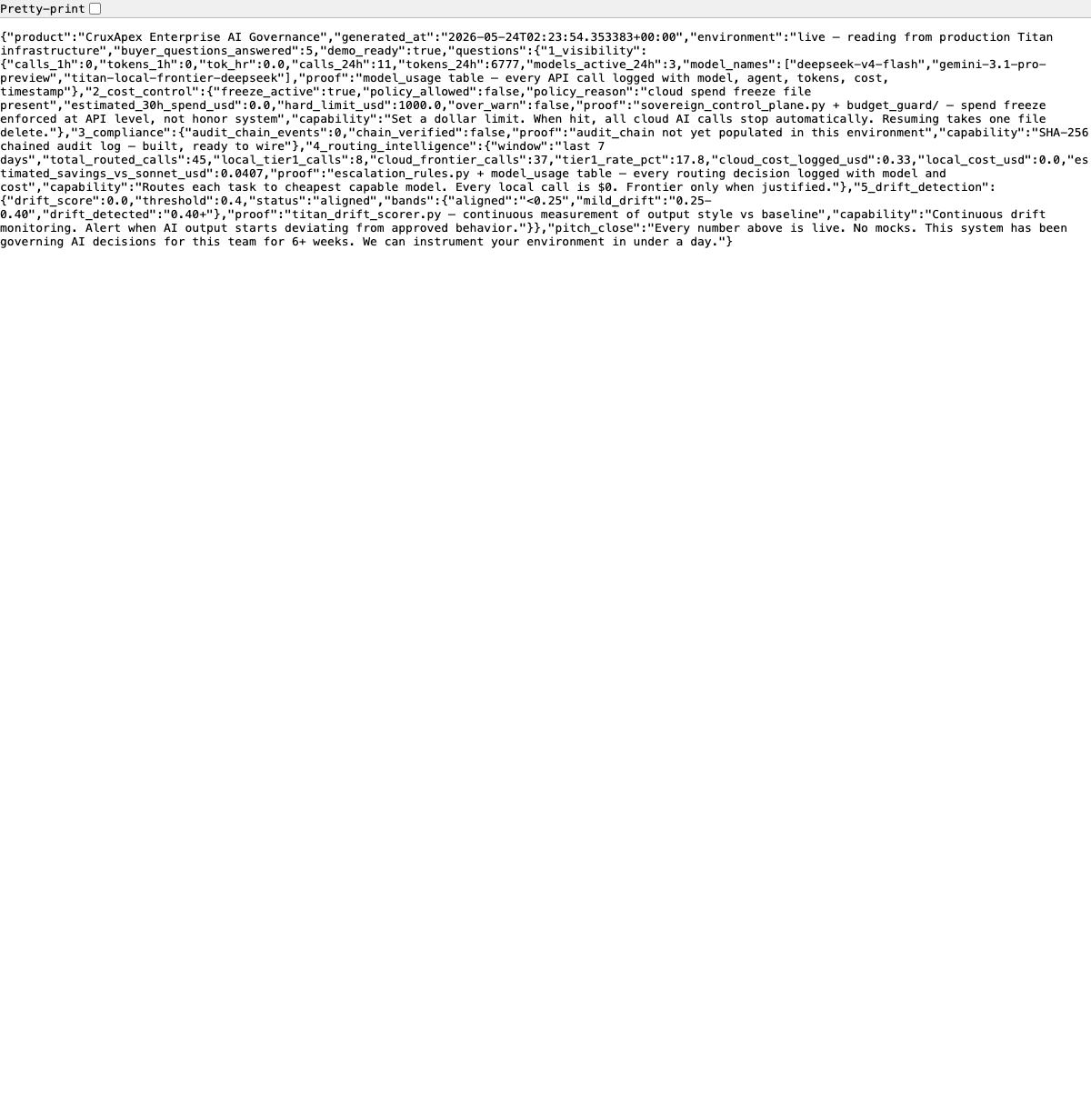
/demo/governance-proof. It shows agent identity, policy, review, drift, and audit evidence fields from system data.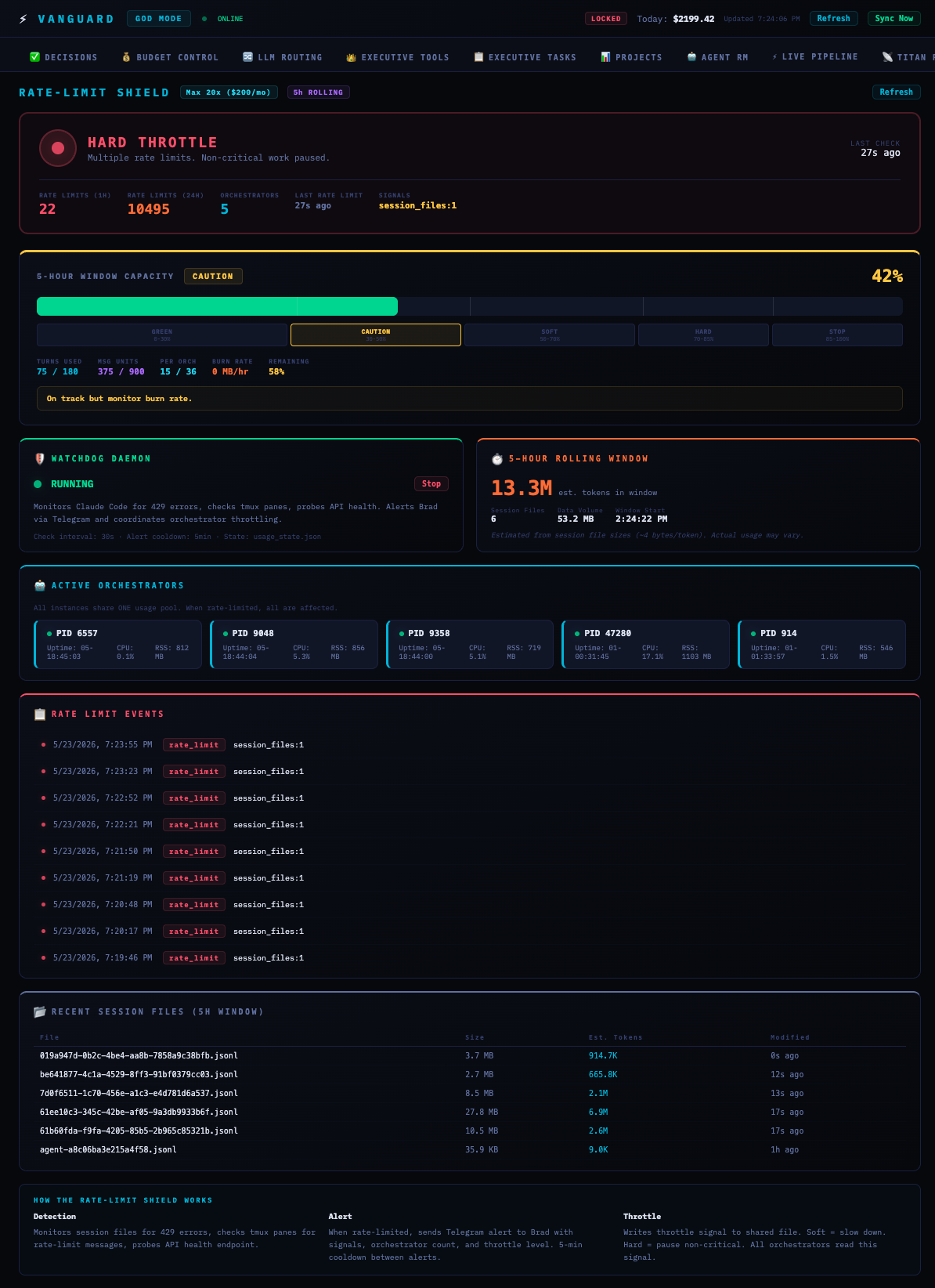
Usage Visibility
Mission Control view of model call activity for operator and buyer inspection.
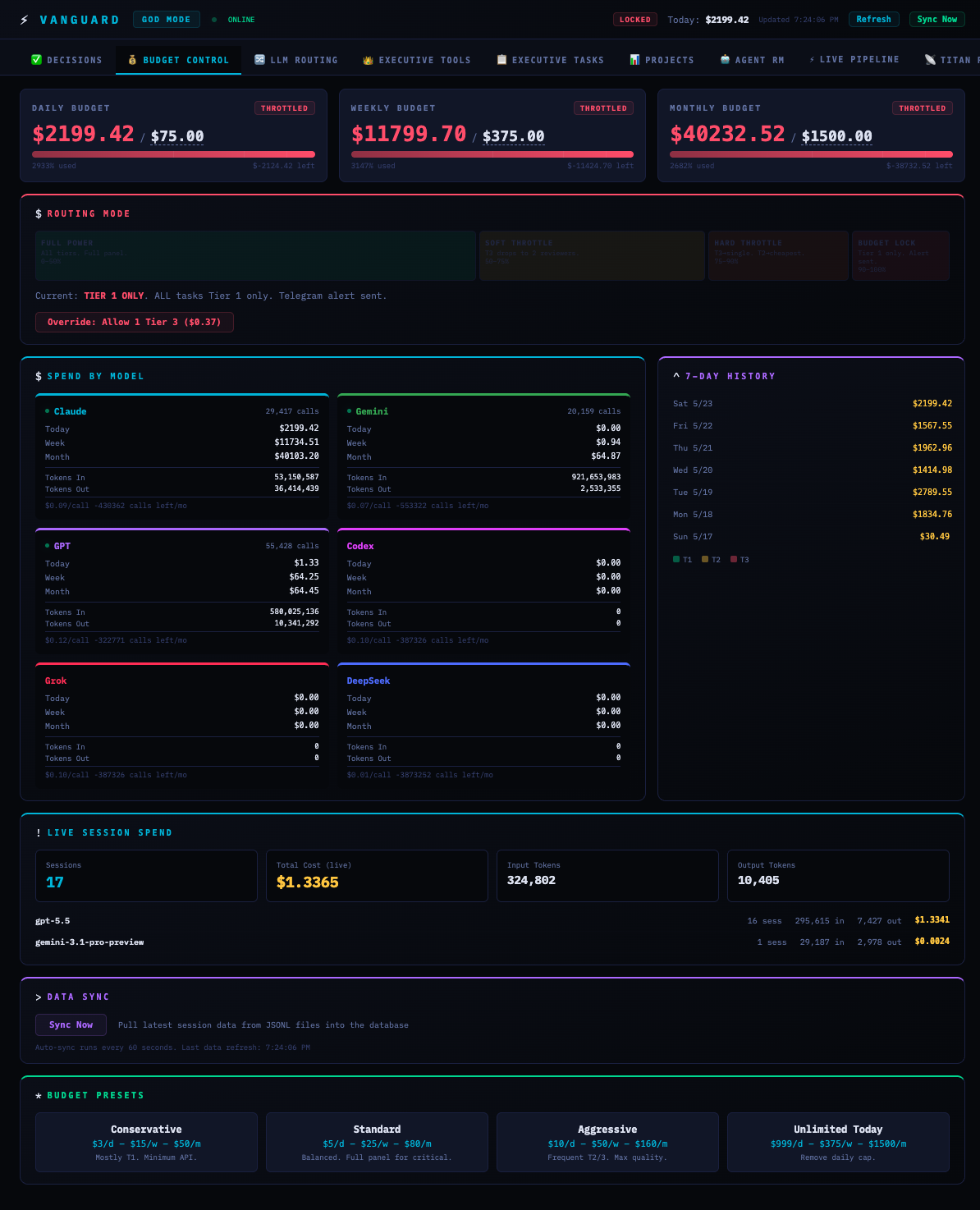
Cost Control
Budget surface for spend and limit monitoring across agent operations.

Routing Intelligence
Local route state for model selection, fallback planning, and governance review.

Capability Inventory
Built-system proof through inventory of available tools and operational surfaces.
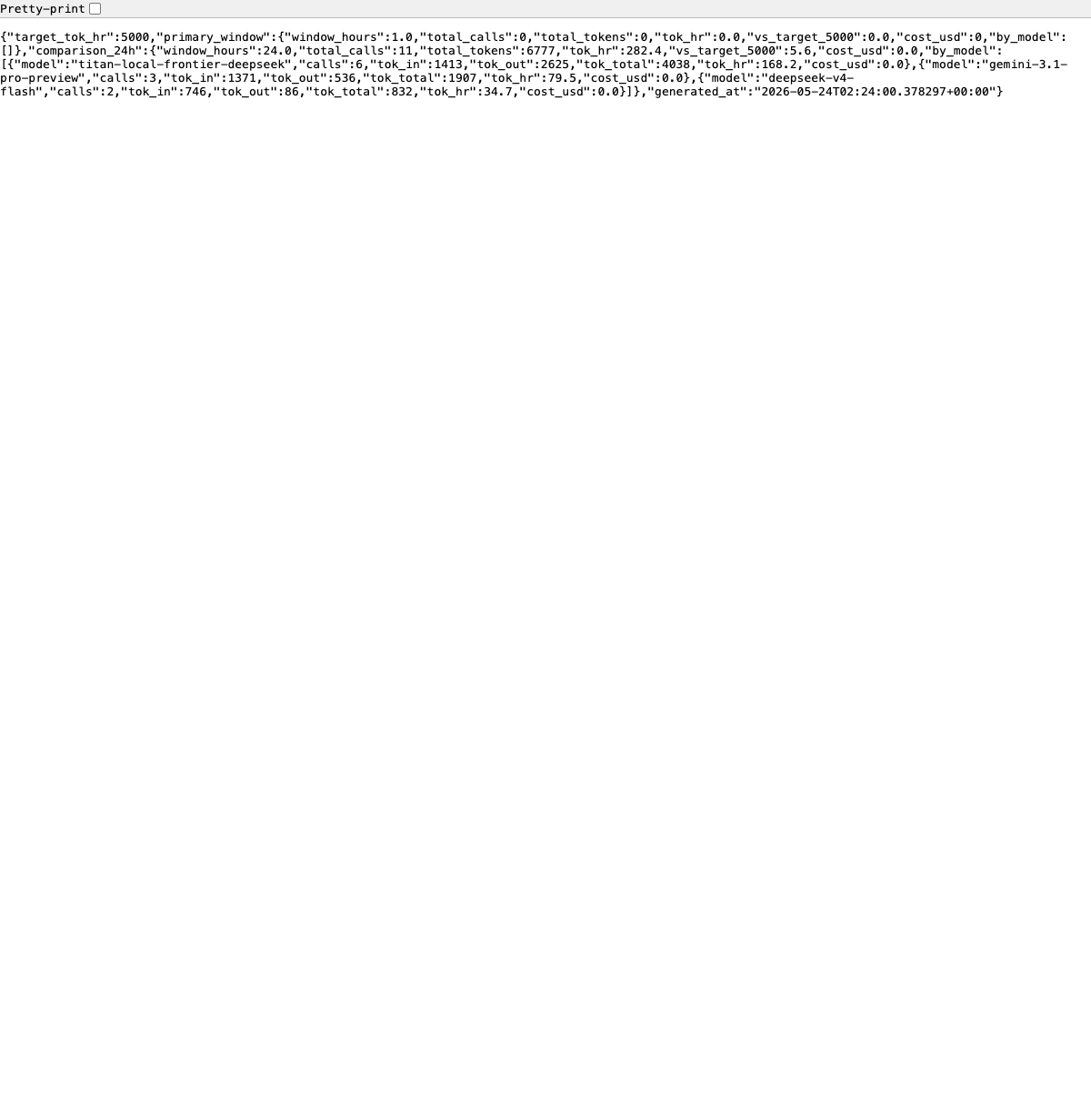
Usage Telemetry
Token-per-hour endpoint evidence for model usage tracking and reporting.
Claim Boundary
These product proof captures show current system capability. They are not customer production evidence or compliance certification claims.
Open-source the governance method. Sell the managed control plane.
The governance method is being packaged as a source-available library. The managed control plane, enterprise support, and compliance reporting are the paid product boundary.
Open Source
- Mandate YAML library and schema
- Local mandate validator
- Council review reference API
- Drift scoring reference API
- Audit-chain example
- PWCS authorization examples
Paid Product Boundary
- Hosted Mission Control
- SSO, RBAC, and enterprise support
- Managed retention and WORM storage
- Compliance report generation
- Customer-specific deployment
- Support SLAs and onboarding
titan-mandates/
  README.md
  LICENSE
  docs/
  mandates/
    schema/
    library/
    examples/
  packages/
    governance_core/
    council_gate/
    drift_monitor/
    pwcs_auth/
    audit_chain/
  examples/
  demo/
  scripts/
Start with a bounded governance pilot.
Register a small set of agents, apply the mandate library, route high-risk decisions through review, and generate an audit packet your compliance team can inspect.
Week 1
Map agents, policies, high-risk actions, and required evidence.
Week 2
Run policy gates, council review, drift scoring, and audit export on sample workflows.
Week 3
Review findings with security, risk, compliance, and executive stakeholders.